The Complete Guide to Vegetarian & Jain Food on Halong Bay Cruises

If you eat pure vegetarian or Jain, "the cruise has vegetarian food" is the start of the question, not the answer to it. A kitchen that adds a plain dal and rice to its regular menu when asked is technically offering vegetarian food. So is a kitchen that runs a dedicated Indian vegetarian line with a cook who's actually made Jain thali before. Both get described the same way on an operator's website, and the gap between them is exactly what you're stuck with once you're two days into an overnight cruise you can't leave.
This guide is the deep, vegetarian-and-Jain-specific version of the general overview on our homepage. Everything here goes further than that page can: what "pure vegetarian" and "Jain" actually exclude and why the difference matters to a kitchen that's never cooked either, what advance notice you should expect to give, how to verify a kitchen isn't cross-contaminating your food, what a real onboard thali looks like, and where the common booking mistakes happen. Every claim is labeled as either independently confirmed or operator-stated-but-unverified, the same discipline used throughout this site.
TL;DR: Most established Halong Bay cruise operators can accommodate a vegetarian request with enough advance notice: commonly around a week, though this varies by operator and isn't universal. Jain requirements (no onion, no garlic, no root vegetables) need more specific confirmation and typically more notice, often around two weeks, because they depend on the kitchen genuinely separating ingredients and utensils, not just leaving meat off the plate. "Vegetarian" in a Vietnamese or Western sense may still include egg. Specify pure vegetarian if that matters to you. This guide covers notice periods, cross-contamination verification, what's actually served, booking mistakes, and named operator comparisons, with direct links to go deeper on each.
Pure Vegetarian vs. Jain: What Each Term Actually Excludes
"Vegetarian" gets used loosely enough that it doesn't always mean the same thing to a Vietnamese kitchen as it does to an Indian traveler, and that gap is where the first misunderstanding usually happens.
Pure vegetarian, in the Indian sense, means no meat, no fish, and no egg. A Western or Vietnamese menu labeled "vegetarian" may still include egg unless you specify otherwise: egg-based dishes are a common default filler on menus built for a general international audience, not an Indian vegetarian one. Jain food goes further still: no onion, no garlic, and no root vegetables (potato, carrot, beetroot, and similar). The reasoning is that harvesting a root vegetable is considered to harm the plant in a way that eating its above-ground fruit or leaf doesn't. A kitchen that hasn't cooked Jain food before frequently doesn't know this distinction exists at all. That's exactly why a vague "yes, vegetarian is fine" from a booking agent isn't the same thing as a confirmed Jain accommodation, and why the two terms need to be specified separately, not treated as points on the same scale.
Read the full comparison: Pure Veg vs Jain vs Vegan on a Halong Bay Cruise →: the practical differences between all three, including where vegan overlaps with Jain and where it doesn't.
How Much Advance Notice You Should Expect to Give
One Halong Bay cruise operator's own published guidance gives a useful illustrative benchmark. Their site states a standard vegetarian request needs about a week's notice, while a Jain request needs roughly two weeks, because Jain preparation requires more kitchen-side planning (Halong Bay Lux Cruises, retrieved 2026-09-23). Treat that as a typical timeline in this niche, not a universal rule. The actual number varies by operator, vessel size, and how far in advance the kitchen provisions its ingredients, and it's exactly the kind of detail worth confirming directly before you book rather than assuming.
Read the full guide: How Much Advance Notice Do Halong Bay Cruises Need? →: notice-period specifics by operator, what happens if you book late, and how to phrase the request so you get a specific answer instead of a vague one.
Cross-Contamination: The Question Most Travelers Forget to Ask
A kitchen can technically serve a "vegetarian" dish that was cooked in the same pan as meat, or a "Jain" dish that still used garlic-infused oil as its base, and neither failure shows up on a menu description. This is the detail vegetarian and Jain travelers most often don't think to ask about until it's too late, because "we have a vegetarian option" and "we have a genuinely separated vegetarian prep line" sound identical in a booking confirmation email and are not the same claim.
A request that gets a specific, useful response looks something like this: "We need pure vegetarian, Jain-style meals for two people: no onion, garlic, or root vegetables, and please confirm whether these will be prepared using separate utensils from non-vegetarian dishes." A useful reply names specific dishes and confirms the utensil question directly. A reply that just says "yes, we can arrange vegetarian food" without addressing either point is worth a follow-up before you rely on it.
Read the full guide: Cross-Contamination on Cruise Kitchens →: what Jain travelers should specifically ask, and what a kitchen's answer actually tells you about how seriously the request will be handled.
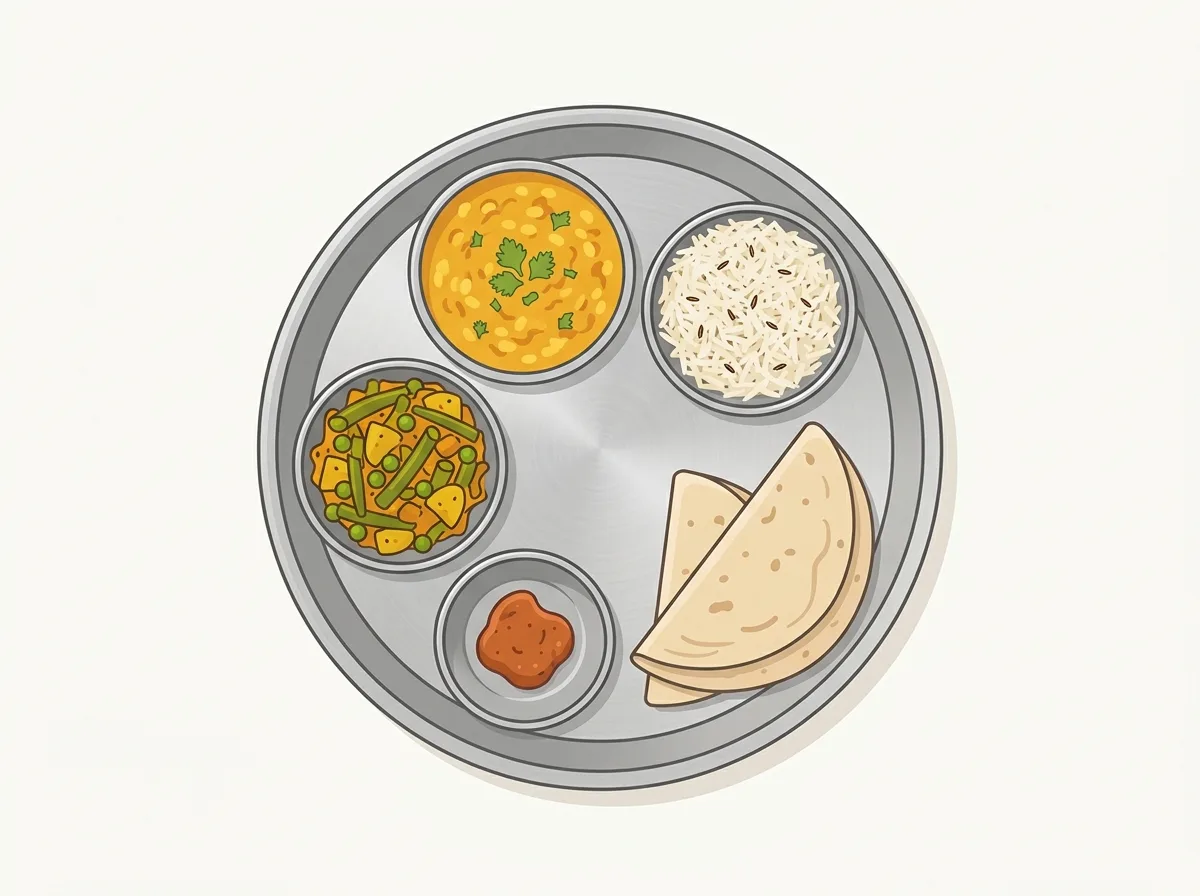
What an Indian Vegetarian Thali Actually Looks Like Onboard
Knowing what to expect on the plate makes it much easier to tell a real accommodation from a token one before you book, and much easier to spot a problem the moment food arrives, rather than three meals in.
Common defaults on a genuine Indian vegetarian thali: dal, steamed rice, roti or chapati, a dry vegetable sabzi, and plain curd. A Jain version substitutes root-vegetable dishes for ones built around above-ground vegetables and pulses, and skips onion-garlic bases entirely in favor of asafoetida or other Jain-compliant flavoring. A kitchen that's actually done this before can usually describe two or three specific dishes without hesitating; a kitchen that's improvising tends to default to plain rice, dal, and not much else.
Read the full guide: What an Indian Vegetarian Thali Looks Like on an Overnight Cruise →: plus our general roundup of which cruises run an onboard Indian cook, the broader version of this same question that isn't vegetarian-specific.
Vegetarian Restaurants in Halong Bay Town
If your cruise can't fully confirm its onboard accommodation, or you're spending a night in town before or after your cruise, Halong Bay itself has land-based vegetarian options worth knowing about. That's genuinely useful for the same reason a halal traveler benefits from knowing RedCoral exists on land: a boat you can't leave has no backup plan, but a hotel night in town does.
Read the full guide: Vegetarian Restaurants in Halong Bay Town →: named options with the same verification caveat applied throughout this site: treat a listing as a lead to confirm, not a guarantee.
Best Halong Bay Cruises for Vegetarian Families with Kids
Traveling with children changes the calculus a little: a picky eight-year-old and a strict Jain grandparent don't have the same tolerance for "we'll figure something out," and a family group usually can't easily split across two different meal plans on the same boat.
Read the full guide: Best Halong Bay Cruises for Vegetarian Families with Kids →: what to look for specifically when booking for a mixed-age group, not just an individual traveler.
Common Mistakes Indian Travelers Make Booking Vegetarian Cruises
The same handful of mistakes shows up repeatedly across traveler accounts and operator FAQs: assuming "vegetarian" and "Jain" are interchangeable when confirming a booking; accepting a verbal "yes, no problem" without it appearing in writing anywhere; not asking the cross-contamination question at all; and booking late enough that the kitchen has no real lead time to plan, then being surprised when the result is thinner than expected.
Read the full guide: Common Mistakes Booking Vegetarian Halong Bay Cruises →: the specific mistakes, and what to do differently at each step of booking.
Vegetarian Halong Bay Cruises Compared
Ambassador Cruise, Omkara Cruise, Halong Apollo Day Cruise, and Paradise Elegance/Grand all publicly claim some form of Indian vegetarian accommodation, with meaningfully different depth behind the claim: from a dedicated Indian-run kitchen to a single pre-arranged dish. The same "claimed vs. independently verified" labeling used throughout this site applies to every operator named here.
Read the full comparison: Vegetarian Halong Bay Cruises Compared →: a side-by-side comparison built specifically around vegetarian and Jain accommodation, distinct from the broader independent cruise comparison guide that covers booking and logistics generally.
What Makes This Guide Different
Vegetarian coverage is less thin than halal coverage across the Halong Bay cruise market, but it's still mostly written by the operators trying to sell you a specific cruise, which means the comparisons, where they exist at all, aren't neutral. This guide is built differently, on the same three points that anchor every guide on this site:
- We separate pure vegetarian from Jain explicitly, rather than treating them as the same request at different strictness levels: a distinction that changes what a kitchen actually needs to do, not just what it needs to avoid serving.
- We label every operator claim by verification status. Where a detail is operator-stated and not independently confirmed, it says so, rather than presenting a marketing claim as settled fact.
- We link you into genuinely deep, single-topic guides for each specific question: notice periods, cross-contamination, real menus, mistakes to avoid, rather than trying to cover all of it shallowly on one page.
Conclusion
Vegetarian and Jain food is genuinely available on a real, growing number of Halong Bay cruises, but the gap between a token accommodation and a kitchen that actually knows what it's doing is wide, and the only way to know which one you're booking is to verify the specifics before you pay. Start with notice periods if you're early in planning, or cross-contamination if you already have a cruise in mind and want to verify it properly. If you're still deciding between operators generally, our independent cruise comparison guide covers the same verification discipline across every dietary need, not just vegetarian and Jain. Spotted an operator detail that's changed since we last checked, or have a Jain-specific question this guide doesn't answer? Contact the editorial team.
Continue Reading
This Guide's Full Cluster:
- Jain Food on Halong Bay Cruise: What Kitchens Can (and Can't) Guarantee
- How Much Advance Notice Do Halong Bay Cruises Need?
- Pure Veg vs Jain vs Vegan on a Halong Bay Cruise
- Cross-Contamination on Cruise Kitchens
- Real Menu: What an Indian Vegetarian Thali Looks Like
- Vegetarian Restaurants in Halong Bay Town
- Best Halong Bay Cruises for Vegetarian Families with Kids
- Common Mistakes Booking Vegetarian Halong Bay Cruises
- Vegetarian Halong Bay Cruises Compared
Related: