Day Cruise vs Overnight: Does Halong Bay Day-Cruise Indian Food Actually Differ?

Yes. Not because one format cares more about Indian food than the other, but because of a simple operational fact: a day cruise only has to get one meal right. An overnight cruise has to get two or three in a row, on a boat you can't leave if something goes wrong. That difference shapes what "Indian food available" actually means in practice, more than which operator you pick.
Key Takeaways
- Day cruises typically serve one meal (usually lunch), which is easier for a kitchen to get right and lower-risk if you're testing a strict dietary requirement for the first time.
- Overnight cruises need variety across 2-3 meals with no way to restock mid-trip: a bigger operational lift, but the payoff is a fuller experience when the kitchen genuinely delivers.
- "Lunch only" on a day cruise is often a simpler, more compact meal than what the same operator serves on an overnight itinerary. Ask specifically what's included, not just whether Indian food is offered.
What a Day Cruise Actually Has to Deliver
A typical Halong Bay day cruise runs 6-8 hours: board mid-morning, cruise out, stop for a cave or kayaking activity, serve lunch, cruise back, disembark before evening. Food-wise, that's one meal, usually lunch, occasionally with a light snack or tea service added. Halong Apollo Day Cruise is one of the few day-trip operators that states it offers Jain meal options on request, positioned as a specific differentiator for exactly this reason: a day cruise is a lower-commitment way to test whether an operator's kitchen can actually deliver your dietary requirement, since if the meal disappoints, you're back on land within a few hours rather than stuck with the same kitchen for another day and a half.
That single-meal structure also means less room for a mistake to compound. If a day-cruise kitchen gets your Jain or halal request wrong, you know immediately, you can address it on the spot or simply not eat much and get a real meal once you're back in town. On an overnight cruise, the same mistake at dinner means either going without until breakfast or accepting whatever workaround the kitchen offers, with no alternative restaurant to walk to.
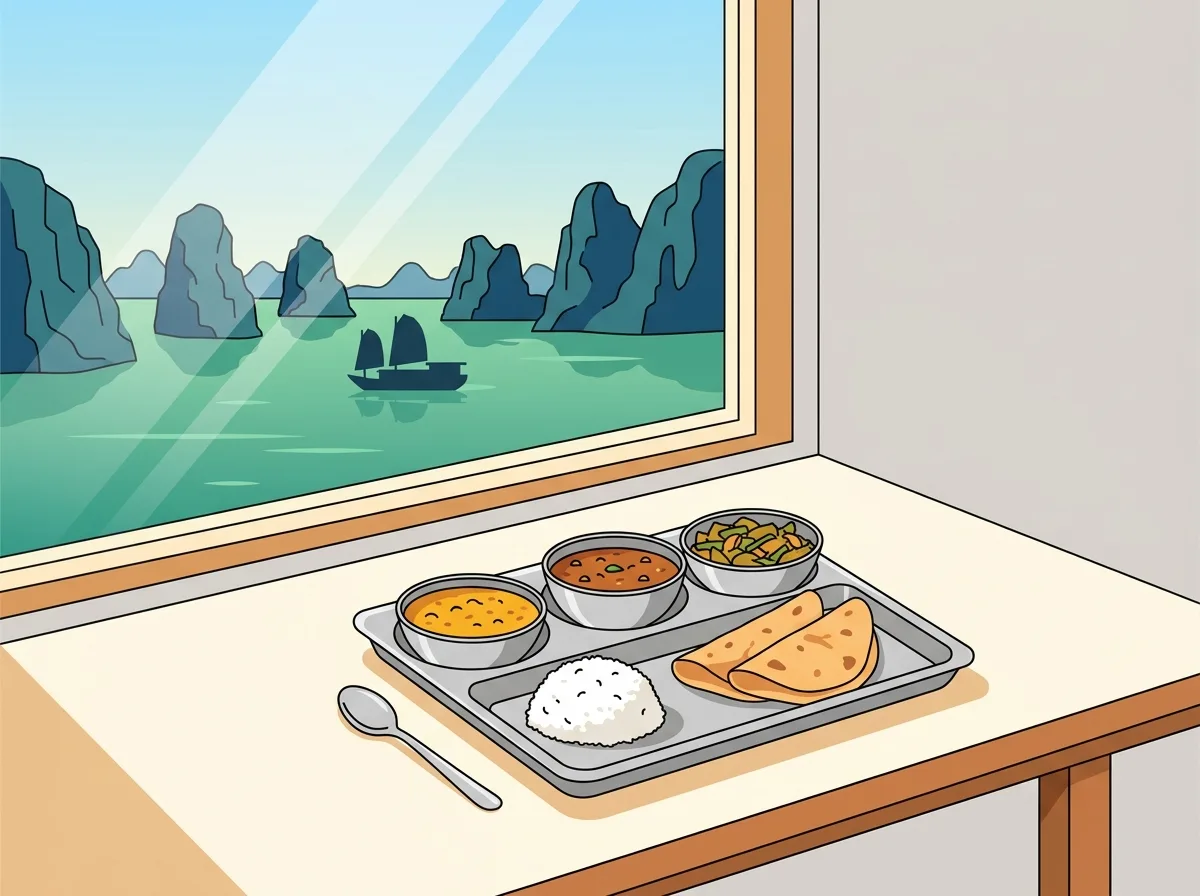
What an Overnight Cruise Actually Has to Deliver
A 2D1N (two-day, one-night) cruise needs lunch on day one, dinner, breakfast on day two, and sometimes a light lunch before disembarking: three to four meals from the same kitchen, for the same guests, without repeating dishes too obviously. A 3D2N cruise adds another full day on top of that. That's a materially bigger lift for a kitchen than a single day-cruise lunch, for three specific reasons:
- Provisioning is fixed before departure. A day-cruise kitchen buys for one lunch service. An overnight cruise's galley stocks ingredients for the whole trip before leaving port. If it runs short of a specific dal, vegetable, or spice on day two, there's no supermarket to send someone to. See our full guide on what happens if the kitchen runs out of an ingredient mid-cruise for the practical version of this question.
- Variety becomes a real constraint. Serving the exact same thali twice in 36 hours is a noticeably worse experience than serving it once. A kitchen with genuine Indian-cooking capacity can rotate dishes across meals; a kitchen accommodating you as an exception often can't, and that shows up more on longer trips.
- There's no walking away. If day-one dinner is a disappointment, you're not choosing between "eat this" and "find another restaurant." You're choosing between "eat this" and "wait until breakfast," on a boat in the middle of the bay.
None of this means overnight cruises are a worse choice. Most trips go fine, and an operator with a genuine dedicated Indian kitchen (see our roundup of cruises with an onboard Indian cook) is built precisely to handle this multi-meal demand well. It means the stakes of picking the right operator are higher the longer you're on board.
Comparison at a Glance
| Day Cruise | Overnight Cruise (2D1N/3D2N) | |
|---|---|---|
| Meals to get right | 1 (usually lunch) | 2-4 |
| Ability to walk away if it's wrong | Yes, back on land same day | No, stuck until the next port stop or disembarkation |
| Provisioning flexibility | Bought same-day for one service | Fixed before departure, can't restock mid-trip |
| Menu variety needed | Low: one meal, one menu | Higher: must avoid repeating dishes across 2-4 meals |
| Typical meal format | Compact lunch, sometimes a simplified thali | Fuller service, more courses over multiple sittings |
| Best for | Testing a strict requirement (Jain, halal) with low risk | Travelers who've confirmed a specific operator's kitchen can handle multi-day variety |
So Which Should You Book?
If your dietary requirement is strict (Jain, halal-certified specifically) and you haven't verified a specific operator's kitchen directly, a day cruise is the lower-risk way to experience Halong Bay without betting an entire overnight trip on an unconfirmed claim. If you want the fuller Halong Bay experience (the overnight anchorage, sunrise on the water, kayaking at dawn) and you're going to do an overnight cruise regardless, the right move is to confirm the operator's multi-meal capacity specifically (not just "do you have Indian food," but "what will you actually serve across all three meals on my trip") before you book, using the red flags to watch for as a checklist.
Either way, "lunch only" on a day cruise is worth asking about directly rather than assuming it matches what the same operator's marketing page shows for its overnight product. A compact day-trip lunch and a full overnight thali service are often genuinely different offerings from the same kitchen, priced and staffed differently. See our guide to how much Indian food adds to your cruise price for how that difference tends to show up in cost.
Booked a day or overnight cruise recently and noticed the Indian food didn't match what's described here, or have a specific operator you'd like us to look into? Let the editorial team know so we can verify it and keep this guide accurate.