How Much Does Indian Food Add to Your Halong Bay Cruise Price?
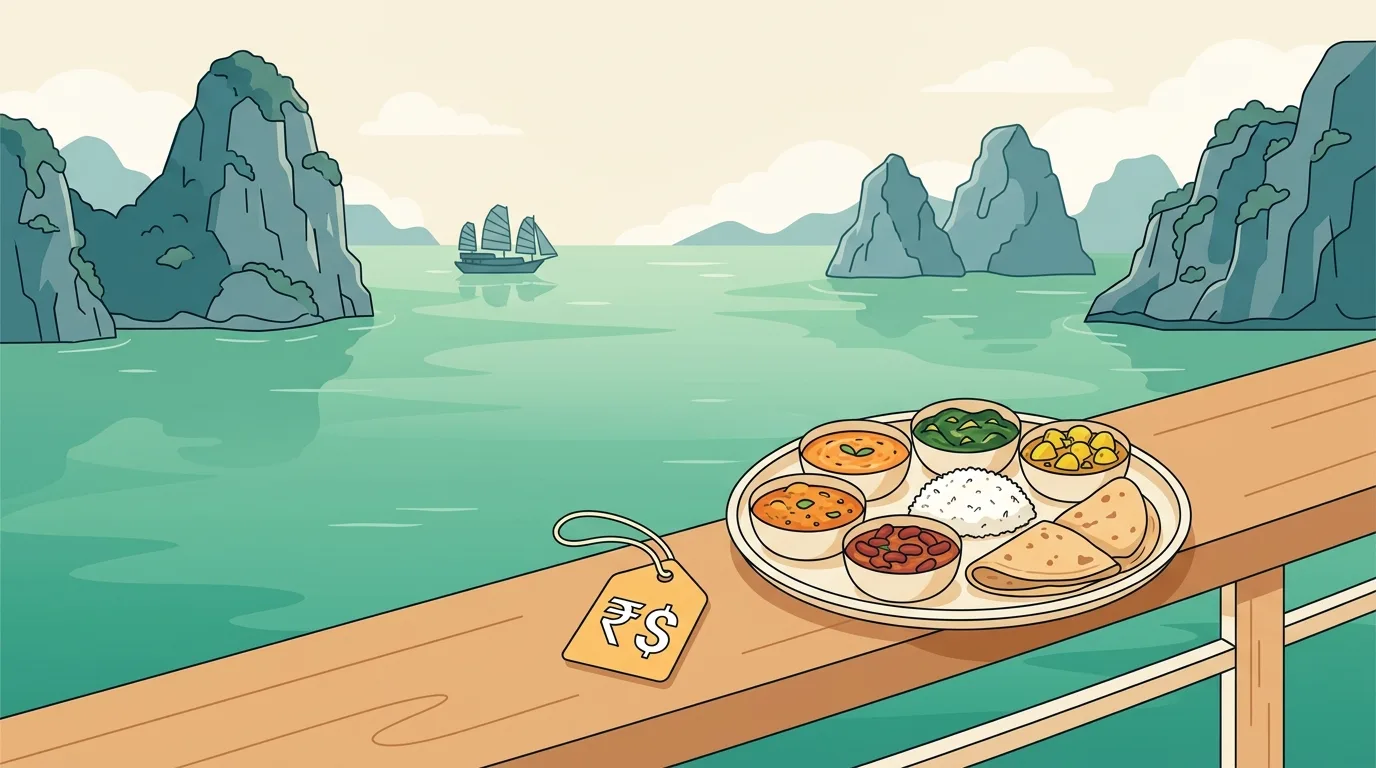
Short answer: no Halong Bay cruise operator publishes a specific "Indian food surcharge." There's no clean number to quote you. What actually drives the price difference is which tier you book: Indian-food capability and price tier are correlated, not because anyone is charging extra for the food itself.
Key Takeaways
- No operator we found publishes an explicit Indian-food add-on fee: it isn't priced as a line item.
- Indian food capability tracks with vessel tier: budget and day-trip cruises run one shared kitchen, luxury vessels more often have room for a separate Indian line.
- Omkara Cruise is the named exception: a mid-range option built specifically around an Indian kitchen, not a luxury add-on.
- General (not Indian-food-specific) Halong Bay cruise costs run roughly $108–$300 per person for one night and $206–$550 for two nights, per a general travel-cost guide. Treat as a rough starting point, not a quote.
Is There an "Indian Food Surcharge" on Halong Bay Cruises?
No, not as a distinct, published fee. Across the named operators this guide tracks (Ambassador Cruise, Omkara Cruise, Halong Apollo Day Cruise, Paradise Elegance/Grand), none publish a separate line-item price for Indian food, vegetarian meals, Jain accommodation, or halal requests. It's built into the base cruise price, or it isn't offered at that vessel at all.
That's different from how some hotels or tour packages price dietary accommodation, where you sometimes see an explicit "special meal" fee. On Halong Bay cruises, the food offering is one part of what you're buying at a given price tier, not an optional add-on you tick a box for.
What Actually Drives the Price Difference
The pattern that matters isn't "Indian food costs X more." It's that the vessels most capable of doing Indian food well tend to sit in specific price bands, for a structural reason: kitchen space and staffing.
| Price Tier | Typical Kitchen Setup | Indian Food Capability (general pattern) | Named Example |
|---|---|---|---|
| Budget / day-trip | One shared kitchen, limited galley space | Accommodated dish at best, on request | Halong Apollo Day Cruise (Jain option on request) |
| Mid-range | Usually one kitchen, occasionally a dedicated line | Ranges widely. Omkara is the standout exception here | Omkara Cruise (Indian-run kitchen, mid-range pricing) |
| Luxury / overnight | More galley space and staffing | Most likely to run a genuinely separate Indian kitchen or chef | Ambassador Cruise, Paradise Elegance/Grand |
A note on how to read this table: this is a general pattern observed across the four named operators this guide tracks, not a rule that holds for every cruise on the market, and the tier label for each named operator is drawn from that operator's own marketing positioning, not an independent price audit. Omkara specifically breaks the pattern: a mid-range vessel that built its entire positioning around an Indian kitchen rather than treating it as a luxury extra. Confirm the specific vessel's setup directly rather than assuming price tier alone tells you the answer. See our full operator roundup for more detail on each.
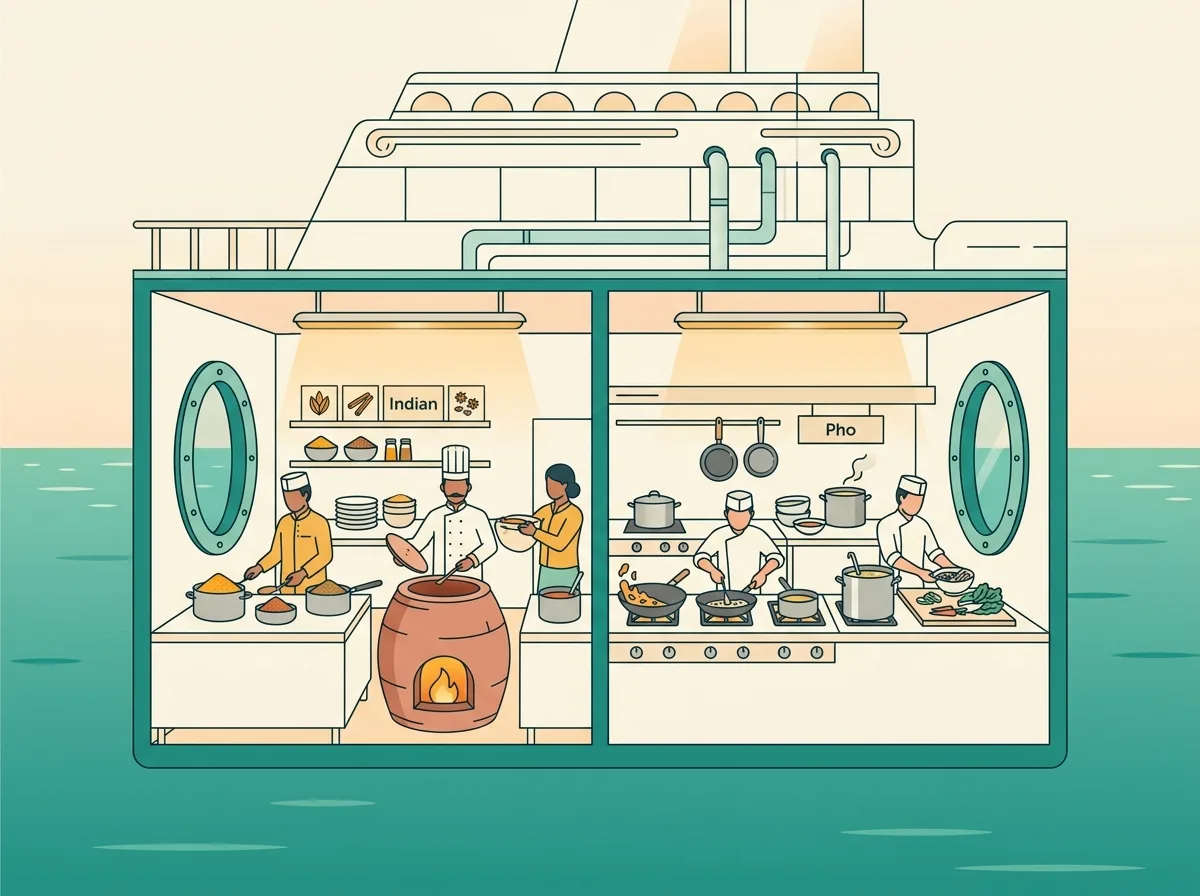
A budget or day-trip vessel typically runs one kitchen for the whole boat. Adding a genuinely separate Indian prep line (different oil, different spice stock, ideally separate utensils for a Jain or halal request) needs galley space and an extra cook that a lower-priced vessel usually hasn't budgeted for. A luxury vessel more often has both. That's the real mechanism behind "luxury cruises tend to do Indian food better," and it's also why a cheap listing that claims a full Indian kitchen is worth double-checking: the economics of it are harder to make work at that price point unless, like Omkara, the whole business is built around it.
What a Realistic Overall Budget Looks Like
Since Indian food isn't priced separately, your starting point is the general cost of a Halong Bay cruise, then you narrow to operators that actually deliver the food capability you need. One general Halong Bay cruise-cost guide puts overnight cruises with food service (of any kind, not specifically Indian) at roughly $108–$300 per person for a one-night cruise, and $206–$550 per person for a two-night cruise, depending on vessel class (Day Trips Vietnam, retrieved 2026-09-23). That's a general travel-content source, not an operator or a specialist Indian-food guide, so treat the range as a rough planning starting point rather than a quote. Pricing shifts seasonally and by operator, so confirm current rates directly before booking.
Within that range, where a specific Indian-food-capable operator lands depends on its own positioning: Halong Apollo Day Cruise sits at the budget/day-trip end (no overnight cabin cost at all), Omkara markets itself as mid-range, and Ambassador Cruise and Paradise Elegance/Grand both sit in the luxury tier. None of these price bands are independently confirmed by this guide yet: they're drawn from each operator's own marketing positioning, the same claimed-not-verified caveat that applies to their food claims. See our full operator roundup for the same caveat applied operator by operator.
Day Trip vs. Overnight: The Cost/Food Tradeoff
There's a second budget variable worth naming explicitly: a day cruise is cheaper largely because it's shorter, not because the food is worse, but it also only has to get one meal right, while an overnight cruise has to get two or three right in a row with no way to leave the boat. That tradeoff is about risk, not just price, and it's detailed in our day cruise vs. overnight Indian food comparison if format is what you're actually deciding between right now.
Questions Worth Asking Before You Compare Quotes
A price comparison between two "Indian food available" listings is only useful once you know what you're actually comparing:
- Is the Indian food described as a feature of this specific vessel, or a general claim on the operator's whole fleet? Some agencies sell multiple vessels under one brand; a low price on the brand's cheapest boat doesn't confirm the same kitchen setup as their flagship.
- Does the quote already include the dietary accommodation, or is it something you need to request and confirm separately after booking? A price that looks competitive can still leave you without a confirmed meal if the Indian-food request was never actually logged.
- If two similarly priced cruises both claim a dedicated Indian kitchen, what's different about the cheaper one? Sometimes it's a genuine deal; sometimes "dedicated kitchen" means different things at each price point. Our red flags guide covers this pattern in more depth.
Next Steps
Once you have a rough budget in mind, the next useful step is comparing specific operators rather than price tiers in the abstract. See our full roundup of Halong Bay cruises with an onboard Indian cook, or go straight to our independent cruise comparison guide if you're ready to weigh named operators against each other. If you're still deciding between a day trip and an overnight cruise, the format comparison covers that tradeoff directly. For the complete picture this page is part of, see the main guide to Halong Bay cruises with Indian food. If a price you were quoted doesn't match what's described here, or you've spotted a rate that looks out of date, contact us and we'll take a look.