What Happens If the Kitchen Runs Out of Vegetarian Ingredients Mid-Cruise?
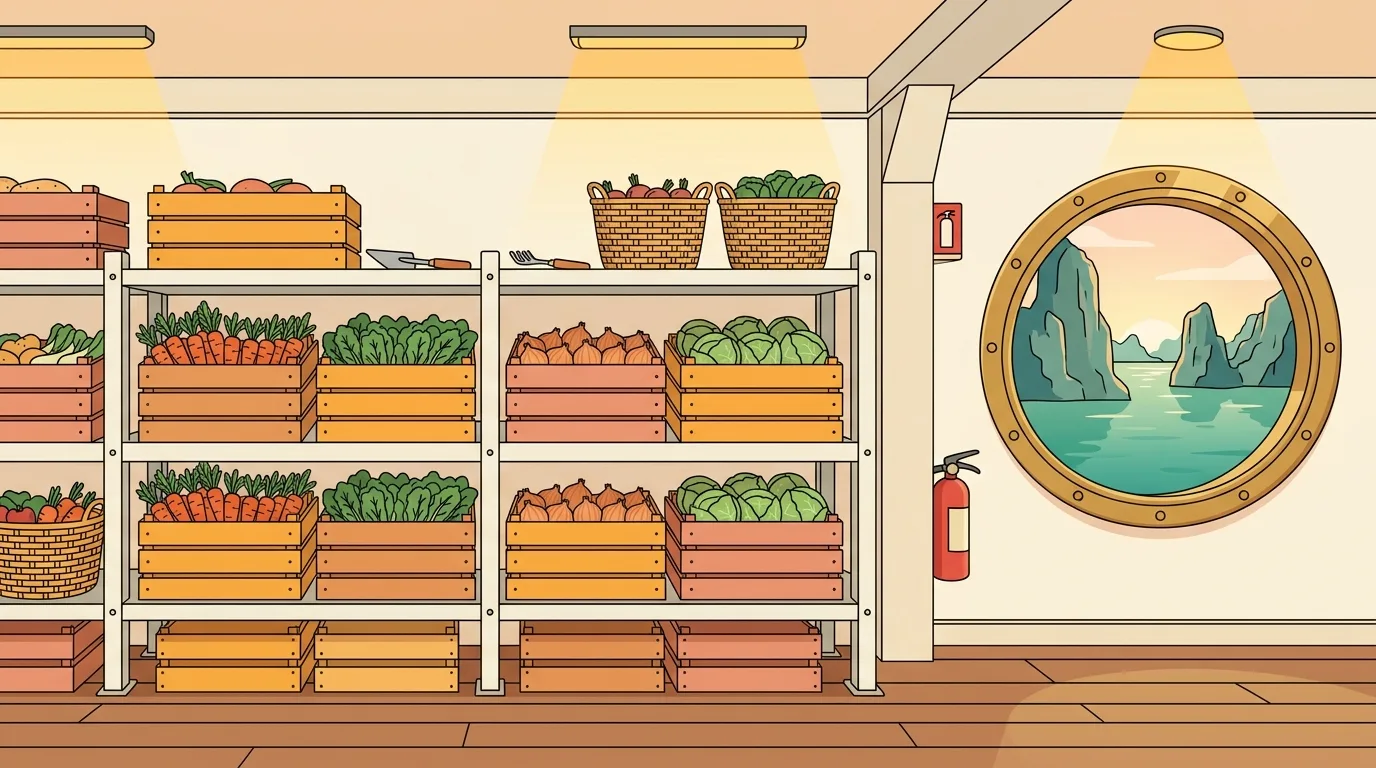
A Halong Bay cruise isn't docked next to a supermarket. Once the boat leaves Tuan Chau harbor, the kitchen is working from whatever it loaded before departure. There's no mid-trip grocery run if it turns out more passengers than expected wanted the vegetarian option, or if a Jain request needs an ingredient the galley didn't stock enough of. This is the operational reality behind a question a lot of guides skip entirely: what actually happens if the kitchen underestimates demand?
Key Takeaways
- Cruise kitchens provision before departure based on the passenger manifest and declared dietary requests. There's no restocking once you're on the water.
- This is the mechanical reason notice period matters: it's not a formality, it's the kitchen's ordering deadline.
- Best case if a kitchen underestimates demand: simpler backup dishes (dal, rice, a basic sabzi). Worst case: genuinely limited variety for the rest of the trip.
- This risk applies more to a 3D2N cruise than a 2D1N one, and far more to an overnight cruise than a day trip. See the comparisons linked below.
Why a Cruise Kitchen Can't Just "Get More"
A land-based restaurant that runs low on an ingredient sends someone to a market or a supplier, often within the hour. A Halong Bay cruise galley doesn't have that option once it's underway: the boat is anchored or moving among the bay's islands, sometimes hours from the nearest harbor with fresh-produce access, and it isn't going to interrupt a two- or three-day itinerary to restock one ingredient. Everything the kitchen serves for the length of the cruise was loaded before you boarded.
That's a specific operational constraint, not a criticism of any particular operator: it's true of essentially every cruise kitchen in the bay, budget or luxury. What varies is how well a given kitchen plans for it, and that planning starts with knowing, in advance, how many vegetarian, Jain, or halal meals it needs to provision for.
This isn't a claim about one operator's kitchen; it's the same fixed-provisioning logic covered across this site's other operator-facing guides: our notice-period guide, our cross-contamination guide, and our operator roundup all describe the same pre-departure ordering constraint from different angles. We haven't independently audited any single kitchen's storage logs, so treat the specific outcomes below as operator-claimed patterns, not a verified statistic.

How Provisioning Actually Works
Before a cruise departs, the kitchen builds its shopping list from the passenger manifest: how many people, how many meals, and (critically) how many of those meals need to be vegetarian, Jain, halal, or otherwise different from the standard menu. This is exactly why our notice-period guide frames advance notice as a provisioning deadline, not a courtesy. A kitchen that finds out about a Jain request the day before departure has, at best, one more supply run to adjust its order. A kitchen that finds out the day you board has already loaded its ingredients and is working with whatever's on the boat.
This is also why a written, pre-confirmed request matters more than a verbal assurance from a booking agent (a point covered in more detail in our cross-contamination guide): if your dietary request never actually reached the kitchen's ordering list, the kitchen isn't "running low" on your ingredients: it never provisioned for them in the first place, which is a worse and more preventable problem than a genuine shortfall.
What Actually Happens If the Kitchen Underestimates Demand
There isn't one universal outcome here: it depends on how far off the estimate was and how the kitchen handles it. Two realistic scenarios:
The more common outcome: simpler, repetitive backup dishes. Most cruise kitchens keep basic vegetarian staples (rice, dal, a simple sabzi, curd) in enough supply to cover an underestimate, because these are pantry staples rather than specialty ingredients. If a kitchen runs short of something more specific (a particular vegetable for a planned dish, say), the practical result is usually a less varied but still edible vegetarian meal, not no vegetarian option at all.
The less common but real outcome: genuinely limited choice for the rest of the trip. If the shortfall is more significant (a kitchen that provisioned for a handful of vegetarian meals suddenly serving many more, or a Jain request that needs specific fresh ingredients the galley didn't load at all), the remaining meals on the cruise can be noticeably repetitive or thin. This is the scenario the notice-period system exists to prevent, and it's also why a written pre-confirmation is worth insisting on: it's the kitchen's evidence, going into its provisioning, of exactly what to plan for.
Neither outcome is common on a cruise where the dietary request was confirmed with adequate notice and in writing. Both become more likely the later a request is made, or the more informal the confirmation.
Why This Makes Written Pre-Confirmation More Important Than It Sounds
A verbal "yes, we can do vegetarian" from a sales agent doesn't necessarily reach the kitchen's actual ordering process: it's a sales confirmation, not a provisioning instruction. A request that's written into your booking confirmation, and ideally reconfirmed by the operator closer to your sailing date, is far more likely to actually shape what gets loaded onto the boat. This is the same logic covered in our booking-mistakes checklist: the gap between "the operator said yes" and "the kitchen provisioned for it" is where most disappointing experiences in this niche originate, not from kitchens being careless once they actually know what's needed.
Does Cruise Duration Change the Risk?
Yes, meaningfully. A 2D1N cruise has the kitchen cover one overnight dinner and one breakfast for your dietary needs: a relatively small, easier-to-estimate ask. A 3D2N cruise adds a second full day of meals, which means more total portions to provision correctly and more opportunity for an early miscalculation to compound by the final meal. See our 2D1N vs 3D2N comparison for the fuller tradeoff. From a pure provisioning-risk standpoint, the extra night is the reason a 3D2N booking deserves slightly more attention to notice period and written confirmation than a shorter trip.
Format matters even more than duration here. A day cruise only has to get one lunch right, and if something goes wrong, you're back on land the same afternoon with other options. An overnight cruise has no such fallback: whatever the kitchen loaded is what's available until the trip ends.
Conclusion
A cruise kitchen's inability to restock mid-trip isn't a flaw to avoid by picking the "right" operator. It's a fixed constraint of cruising in general, and the real safeguard is on your side of the booking: give adequate notice, get the request in writing, and reconfirm close to your sailing date. Handled that way, running short is uncommon. Handled as a same-day verbal request, it's a real and avoidable risk. Start with our notice-period guide to time your request correctly, and our cross-contamination guide for the related question of how, not just whether, your meal gets made. If you've had a different experience with a specific operator's kitchen, or spot something in this guide that needs correcting, contact our editorial team and we'll factor it in.